
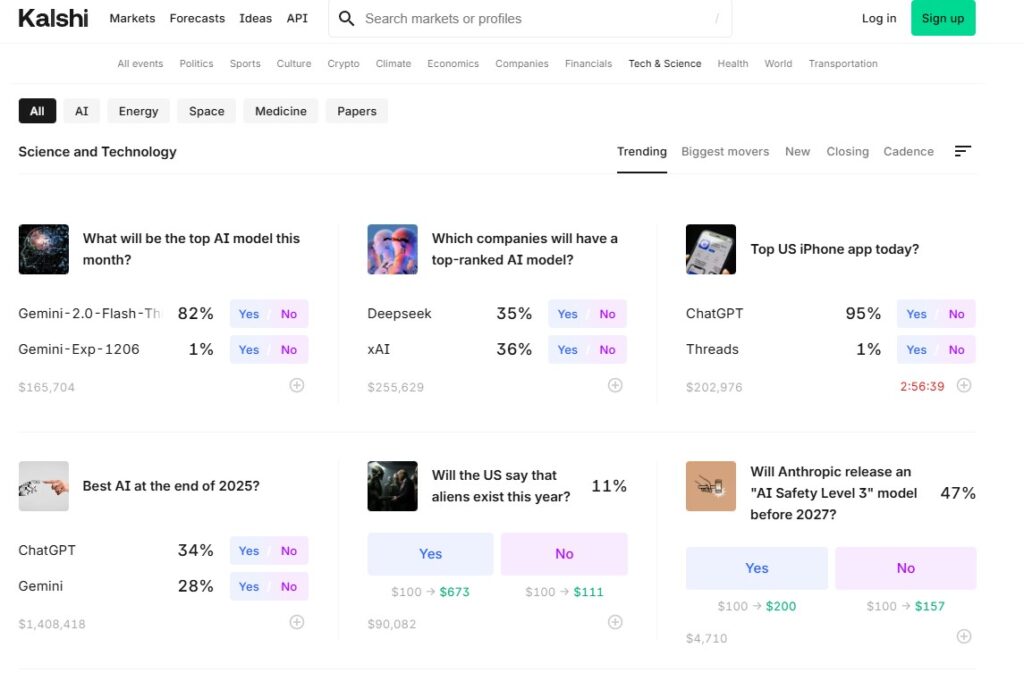
What is Kalshi? A federally regulated exchange for event contracts
Kalshi is an exchange where you trade yes-or-no contracts on real-world events. Will the Fed cut rates? Will it snow in Central Park? Will a team win on Sunday? Each contract pays $1 if the answer turns out to be yes, and nothing if it’s no.
Kalshi is regulated by the Commodity Futures Trading Commission (CFTC) as a designated contract market, the same category of federal license used by futures exchanges. That federal status is the heart of both its appeal and its legal troubles.
You don’t bet against Kalshi. You trade with other users, and Kalshi earns money from trading fees.
How Kalshi works: prices, payouts and an example
Every contract trades between 1 cent and 99 cents. The price reflects what traders collectively think the odds are.
Example: a contract asking “Will CPI inflation come in above 3% this month?” trades at 35 cents for “Yes.”
- You buy 100 “Yes” contracts for $35, plus fees.
- If inflation comes in above 3%, each contract pays $1, so you collect $100.
- If it doesn’t, the contracts expire worthless and you lose your $35.
You don’t have to hold until the result. If the price climbs to 60 cents before the data comes out, you can sell your 100 contracts for $60 and lock in the gain. That ability to exit early is the biggest practical difference from a traditional sports bet.
What you can trade on Kalshi: markets and categories
Kalshi lists markets across several categories:
- Economics: Fed rate decisions, inflation, jobs data and GDP.
- Politics: elections, legislation and government actions. Kalshi won a federal court fight with the CFTC in fall 2024 that cleared the way for its U.S. election contracts.
- Sports: game winners, championships and season-long outcomes. Kalshi expanded into sports by early 2025, and these contracts are what triggered New York’s enforcement.
- Weather and climate: temperatures, snowfall and hurricanes.
- Culture, tech and crypto: awards shows, product launches and asset prices.
Market availability can vary by state and changes as litigation develops. Check what the app shows for your location.
Kalshi fees: the formula, explained
Kalshi doesn’t charge a membership fee or a settlement fee. It charges a trading fee, set out in its fee schedule (effective July 7, 2026).
Taker fee (orders that match immediately with an existing order):
fee = 0.07 × number of contracts × price × (1 − price), rounded up to the next cent
Maker fee (resting orders that are filled later): a lower 0.0175 rate, but only on markets that switch it on. By default the maker multiplier is zero, so resting orders carry no fee unless a market says otherwise. Canceling a resting order costs nothing.
The formula means fees are highest on contracts near 50 cents and shrink toward 1 cent or 99 cents. Buying 100 contracts at 50 cents carries a taker fee of $1.75. Buying 100 at 90 cents costs $0.63.
Kalshi deposits and withdrawals
Kalshi’s fee schedule lists these funding rules:
| Method | Kalshi fee |
|---|---|
| ACH bank transfer | None for deposits or withdrawals |
| Debit card deposit | Up to 2% |
| Wire transfer | No Kalshi fee on deposits; your bank may charge. Wire withdrawals aren’t supported under $500,000 |
| Crypto | Third-party processor fees may apply, disclosed before each transaction |
For most users, ACH is the cheapest route both ways. Kalshi requires identity verification before you can trade or withdraw, and the minimum age is 18.
Kalshi vs. a regulated NY sportsbook
| Kalshi | NY-licensed sportsbook | |
|---|---|---|
| Regulator | CFTC | NY State Gaming Commission |
| Counterparty | Other traders | The sportsbook |
| Minimum age | 18 | 21 |
| Exit before the result | Sell at market price | Cash out, where offered |
| NY self-exclusion | Not covered | Covered |
| State tax on operator | None | 51% of gross gaming revenue |
That last row explains much of the political fight. New York’s licensed sportsbooks pay 51% of their revenue to the state. Kalshi pays none of it.
Is Kalshi legal in New York? The lawsuit and where it stands
New York says Kalshi’s sports and election contracts are illegal, unlicensed gambling. Kalshi says federal law puts it under the CFTC alone. Here’s how the fight has unfolded:
- October 2025: the NY State Gaming Commission sends Kalshi a cease-and-desist letter. Kalshi sues the Commission in federal court in Manhattan.
- July 7, 2026: Judge Analisa Torres denies Kalshi a preliminary injunction, finding that Congress didn’t intend to preempt every state action. Kalshi appeals to the Second Circuit.
- July 29, 2026: a Second Circuit judge denies an emergency injunction and refers the motion to a three-judge panel.
- July 31, 2026: Gov. Kathy Hochul and Attorney General Letitia James sue Kalshi in state court. They seek an injunction, disgorgement, restitution and treble fines. Press reports put the damages sought at $36 billion or more. The suit also notes that 18- to 20-year-olds can trade on Kalshi, while New York sportsbooks require bettors to be 21.
- August 2026: a federal judge denies the CFTC’s emergency request to halt New York’s case. The CFTC then says it may compel Kalshi to keep trading if a New York court orders a shutdown.
- Oct. 30, 2026: New York’s brief in the Second Circuit appeal is due.
No court has issued a final ruling. Courts elsewhere are split: the Third Circuit sided with Kalshi in a New Jersey case in April 2026, and the Ninth Circuit ruled against it in Nevada in August 2026. The question may end up at the Supreme Court.
For the wider picture, including Polymarket, Coinbase and the state’s ORACLE Act bill, see our guide to prediction markets in New York.
Who Kalshi suits, and the risks to know
Kalshi can suit traders who follow economics, politics or weather closely and want a regulated venue with transparent pricing. The ability to sell before a result is a genuine feature.
For New Yorkers, the risks are concrete:
- Access could change suddenly if a court orders Kalshi to stop serving New York.
- No state safety net. New York’s self-exclusion program doesn’t cover Kalshi, and the state gaming regulator won’t hear your complaint.
- Losses are real money. A contract that settles “No” pays nothing.
If you want to bet on sports with full New York oversight, compare the 8 licensed apps in our NY sportsbook rankings. For the legal status of every product in the state, see New York gambling laws.
Kalshi review FAQ
Is Kalshi legit?
Kalshi is a real, CFTC-regulated exchange, and customers trade against each other rather than against the house. Its legality for sports contracts in New York is being fought in court.
Is Kalshi legal in NY?
It’s disputed. New York says Kalshi’s sports and election contracts are illegal gambling and has sued it. Kalshi lost an injunction bid in July 2026, and its appeal is pending.
What is Kalshi?
Kalshi is a federally regulated exchange where you buy yes-or-no contracts on events in economics, politics, weather, culture and sports. Each winning contract pays $1.
How much does Kalshi charge?
Kalshi charges a trading fee of 0.07 × contracts × price × (1 − price) on orders that match immediately. ACH deposits and withdrawals have no fee, and debit card deposits cost up to 2%.
How old do you have to be to use Kalshi?
The minimum age is 18. New York’s lawsuit points to that gap, since state-licensed sportsbooks require bettors to be 21.
21+ and physically in New York. Gambling problem? Call or text 1-877-8-HOPENY (467369).